
Maternity’s Groundhog Day:
Another Report, Another Set of Recommendations, and Another Promise That This Time Things Will Change


Every few years, the NHS maternity service experiences another reckoning, filled with a heartbreaking collection of family testimony, followed by yet another 200-page report with recommendations that promise to transform care.
The Amos Report is the latest, and arguably the most comprehensive. But its existence poses an awkward question: If Morecambe Bay, Better Births, Ockenden, East Kent and Nottingham all identified essentially the same problems, why was another inquiry necessary?
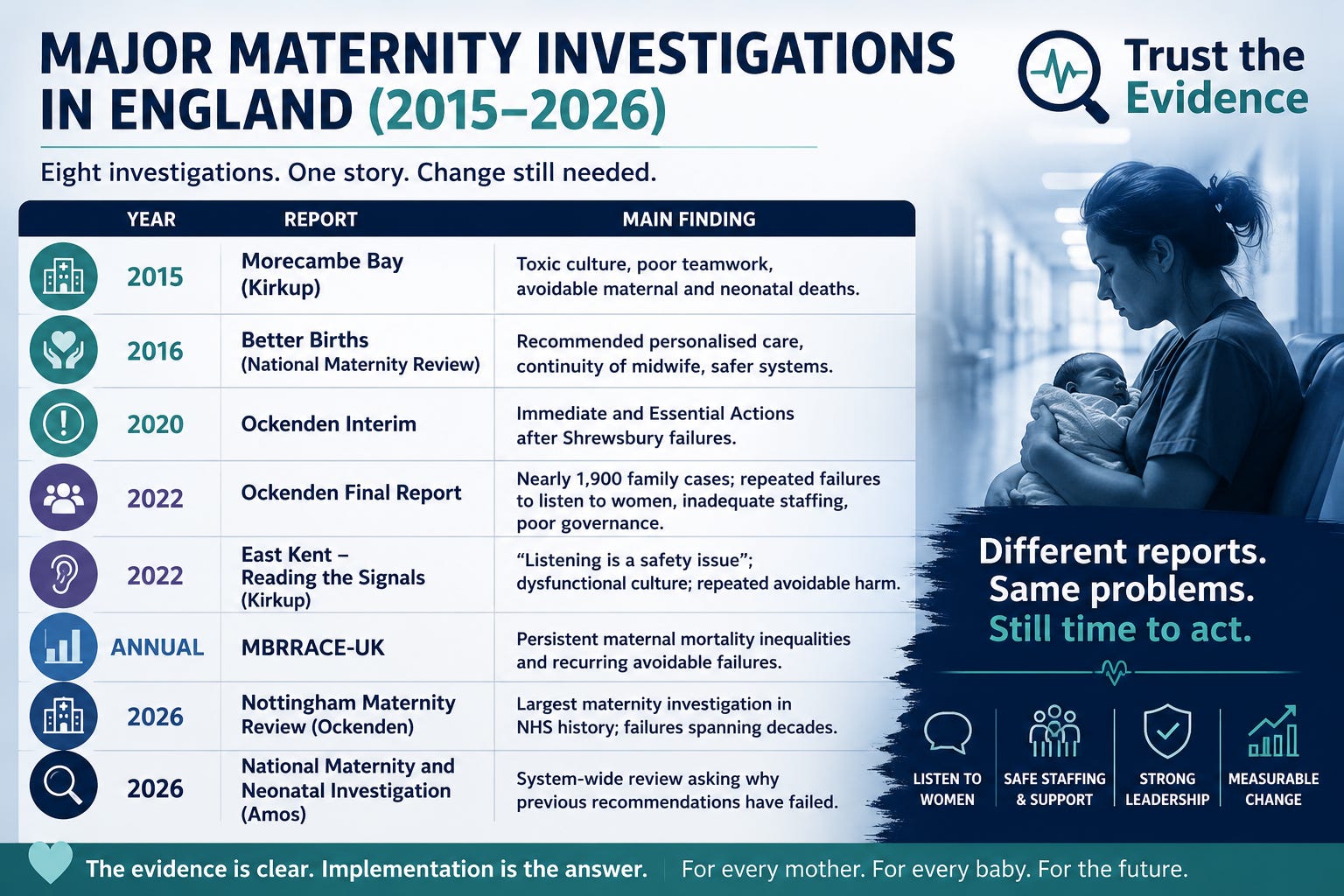
The answer is extremely uncomfortable: We have become exceptionally good at investigating failure and remarkably poor at learning from it.
Read the National Maternity and Neonatal Investigation (Amos Report) here:
The central themes have barely changed over a decade. Women are not listened to; staff work in systems they know are unsafe; poor cultures persist, and learning does not spread and embed in practice. All the time, leadership changes, organisations reorganise, and recommendations from other reports accumulate on the shelf.
The Amos investigation deserves credit for saying this explicitly. It reviewed hundreds of previous recommendations and concluded that the problem is no longer identifying what needs fixing—it’s implementing it. That is perhaps the report’s most important observation.
Yet therein lies the irony: The Amos Report itself is another report.
It joins a growing library of worthy documents that diagnose remarkably similar illnesses with increasingly elaborate organisational prescriptions.
The real danger now is that the NHS has developed an inquiry-industrial complex: every scandal demands an investigation that leads to more recommendations; every recommendation then requires a taskforce and every taskforce eventually produces another investigation.
The Amos report focuses on practical changes clinicians immediately recognise.
Improving maternity triage is long overdue. Improving investigation quality is similarly sensible, and likewise, continuity of care, better postnatal support, interoperable digital records, improved estates and stronger multidisciplinary training are hardly controversial. Treating racism and discrimination as patient safety issues rather than merely workforce issues is also an important conceptual advance. If women are not believed because of who they are, it is unsurprising that their safety suffers.
These recommendations are concrete, measurable and broadly achievable. Unfortunately, many others drift into familiar Whitehall territory.
Take the proposal for a statutory Maternity and Neonatal Commissioner reporting directly to Parliament. One struggles to identify the evidence that creating another national office improves frontline maternity care.
England already possesses NHS England, the Care Quality Commission, Integrated Care Boards, Royal Colleges, MBRRACE, HSIB’s successor organisations, NHS Resolution, professional regulators and multiple maternity safety programmes.
The Amos report argues the problem is fragmentation. Yet one of its headline recommendations is to create another statutory office. Unless powers are transferred from existing bodies, there is a legitimate criticism that another commissioner could increase fragmentation rather than reduce it.
That’s probably the strongest policy critique of Recommendation 1: the report convincingly diagnoses a system with too many organisations and blurred accountability, but its flagship solution is to add another organisation to the landscape. Whether that improves implementation or simply creates another voice in an already crowded system is far from self-evident.
Similarly, the proposed “Modern Service Framework” sounds reassuring but raises an obvious question: how many service frameworks, pathways, standards and guidance documents already exist?
The report itself notes there is an overwhelming volume of guidance. Responding by writing another framework risks becoming circular.
The recommendations for new governance structures, redesigned accountability arrangements and expanded reporting mechanisms also deserve scepticism.
Healthcare rarely fails because there are too few committees; it usually fails because staff lack time, experience, continuity and capacity.
The most striking feature of every maternity inquiry over the past decade is not what changes but what remains stubbornly constant.
Morecambe Bay spoke about poor teamwork; Ockenden spoke about poor teamwork; East Kent spoke about poor teamwork; Nottingham spoke about poor teamwork; and, yes, Amos spoke about poor teamwork again.
Likewise, every inquiry says women were not listened to, identifies workforce pressures, and describes defensive organisational cultures.
This consistency should provoke humility, as the challenge is not discovering new truths; it is delivering old ones.
Perhaps the NHS should impose a moratorium on major maternity inquiries for five years—not because scrutiny is unnecessary, but because implementation has become the rate-limiting step.
No new reports; no new commissioners and no new frameworks.
The next step is then obvious: Publish an annual maternity scorecard that names the trusts succeeding and those falling behind, and measures outcomes rather than intentions.
And if government won’t do it, the TTE Office will. Armed with our shiny new WhatDoTheyKnow Pro subscription, we’ll send identical Freedom of Information requests to every maternity trust in England, publish the results, and keep asking until the answers improve.
Because ultimately families do not need another beautifully written report; they need the last six reports to matter.
That may be the uncomfortable lesson the Amos investigation unintentionally teaches us. Its diagnosis is persuasive, compassionate and deeply researched. But if it joins its predecessors on the shelf, admired yet incompletely implemented, it will merely become another chapter in the NHS’s longest-running maternity story: knowing exactly what to do, and somehow never quite doing it.
This post was written by two old geezers who have spent decades reading inquiries that all reach remarkably similar conclusions. This one deserves to be the last, provided someone finally acts on it.
POSTSCRIPT
We actually think this could become a Trust the Evidence project in its own right. A simple annual dashboard could FOI every trust on metrics such as:
Implementation status of the Ockenden “Immediate and Essential Actions”.
Progress against Amos recommendations that are locally actionable.
Consultant obstetric cover (24/7).
Midwife vacancy rates.
Time to maternity triage assessment.
PMRT completion rates.
Serious incident investigations completed within target.
Birth outcomes (stillbirth, neonatal mortality, HIE).
Patient-reported experience measures.
CQC maternity ratings.
Rather than producing another commentary, we’d rather produce something useful: a reproducible, evidence-based league table of implementation—exactly the sort of accountability that many inquiries have called for but few have delivered.
We’ll publish the methodology, use Freedom of Information requests where necessary, and update the data transparently so that trusts can demonstrate progress, or explain why they haven’t.
If anyone out there has experience building interactive dashboards, data visualisations or open-data projects, we’d love to hear from you. Help us build an independent maternity implementation tracker that measures what matters, not just what gets promised. After a decade of reports, it’s time to start measuring delivery.
I'll refrain from asking why none of these worthy Inquiries seem to address what, for me, looks like the core of the problem. That would be rude and uncouth ...
Instead I looked at this sentence again: "We have become exceptionally good at investigating failure and remarkably poor at learning from it." - and wondered how this could be. After all, aren't we told, again and again and again after every failure and catastrophe, be it in the NHS, be it in the country in general, that 'lessons will be learned'. doesn't it look as if the NHS and the whole of whitehall is constitutionally incapable of actually 'learning lessons'?
Maternity services began to struggle in the 80s when midwife training was cut markedly as a response to a falling birthrate ( just before population increased through immigration) ,Add to this the closure of smaller local maternity units and merging of even larger ones as happened in Sheffield. The result is a stretched hierarchy heavy service. I could go on about young relatives recent experiences but the reports already highlighted the reasons.