
Miracles happen
No evidence required


As part of our daily trawl through NHS England’s relentless stream of good-news press releases, one story caught our eye.
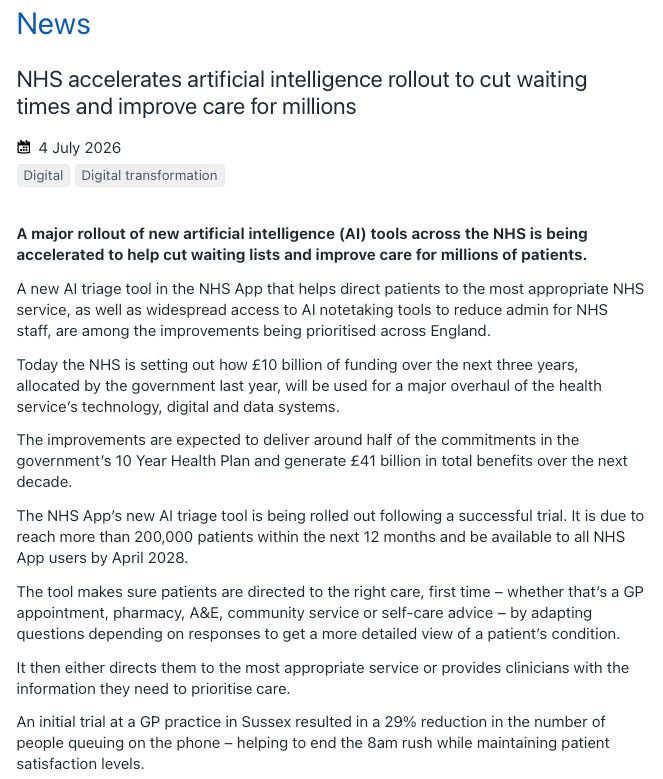
It promised the full modern package: artificial intelligence cutting queues, transforming care and generally making life better for everyone. Click through, and you’re rewarded with no fewer than nine heart-warming tales of bots saving time, saving money and, apparently, saving the NHS itself.
Leaving aside the awkward fact that queueing theory is rather less linear than these simplistic announcements suggest, we looked for the evidence behind the nine triumphant conclusions.
There wasn’t any: we couldn’t find any links, references, or underlying evaluations.
So, in the finest tradition of two suspicious old geezers, we went looking for ourselves.
The strongest evidence we found concerned ambient voice/AI scribes that transcribe consultations and draft clinical notes. The main supporting document appears to be a service evaluation from Great Ormond Street Hospital, not a large randomised trial demonstrating shorter waiting lists or improved patient outcomes.
This is what the Care Quality Commission had to say:
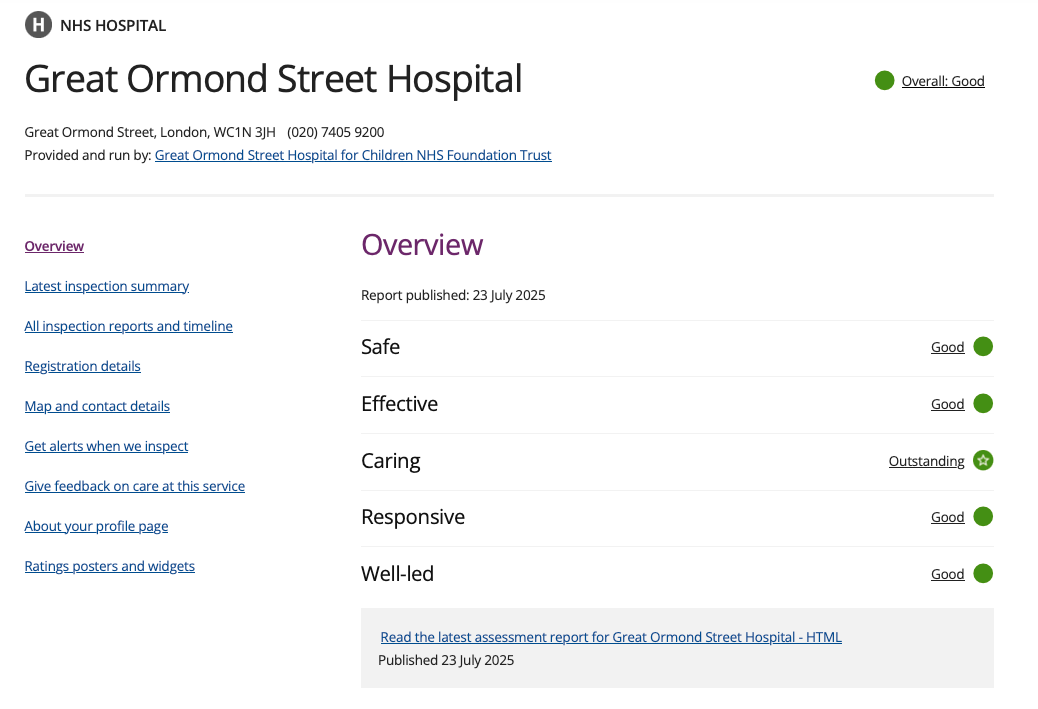
The Hospital webpage also sent us to the hospital’s DRIVE, its digital innovation unit, sponsored by

We looked for something called “methods” but met with no success.
What about the other eight claims?
The grander the claim, the thinner the evidence: “cut waiting times,” “improve care for millions,” and “£41bn in benefits.”
Those may be plausible policy projections, but we could not find publicly available analyses that allow anyone to examine the modelling, interrogate the assumptions or reproduce the results.
Take the Sussex example: NHS England reports a 29 per cent reduction in phone queues—an impressive figure, if true. Yet we could not locate a public evaluation describing how it was measured, what happened to call volumes, whether staffing changed, or whether the reduction persisted beyond the initial implementation.
So what have we got: plausible but unverifiable projections, or facts, or good news masquerading as research to ram the AI agenda down our throats and divert cash from frontline care?
Presently, the public is being asked to take NHS England’s claims on trust; an odd position for an organisation that routinely tells everyone else to follow the evidence.
This piece was written by two old geezers who still believe miracles belong to another elderly gentleman dressed in white who lives in Rome, not to NHS England’s communications department.
The digitisation of the NHS and the rolling out of the digital patient record is absolutely mind boggling.
A relative of mine has just spent over two weeks in a university hospital. What stood out in the ward was the array of digital screens everywhere, and the staff, medical and nursing, spent 90% of time staring at these and tapping on keyboards (OK as this is TTE I didn't actually measure it but that is what it seemed like). I would like to comment on the standard of nursing care, but I cant because there wasn't any! All the caring, such as washing and changing bed linen, even fairly intimate things, was done by family members.
In 1974 when I first walked the wards as a houseman (F1 these days) my first six months was spent on a male ward presided over by Sister Turp who could have taught the leaders of North Korea a thing or two. But boy, did she have standards, and the nurses knew exactly what was expected of them. When I arrived on the ward at 8.00am all the patients were washed, fed, their beds remade with white sheets carefully tucked in. Even the germs were afraid to come out. Turp ruled OK!
All this now seems to have been replaced by cold clinical technology with the patients rather in the way.
Sigh!
We were on a packed train on Sunday when a 90 year-old lady collapsed. The guard (who deserved a medal) halted the train & called 999. The ambulance despatcher's advice was to lay the old lady on the platform (it was 34') & carry on our way. No ambulance was to be sent.
The despatcher was following a protocol, whilst she was human she was constrained by a system, essentially AI imposed on a human despatcher. Under a purely AI system the result will be the same, still no ambulance, but no despatcher & so no guilt.
Eventually another old lady left the train with the collapsed one & we continued on our way, leaving 2 old ladies behind with no ambulance coming.