
Andy Burnham’s “Flu” Problem
“Swine Flu” and the Triumph of Policy Over Evidence


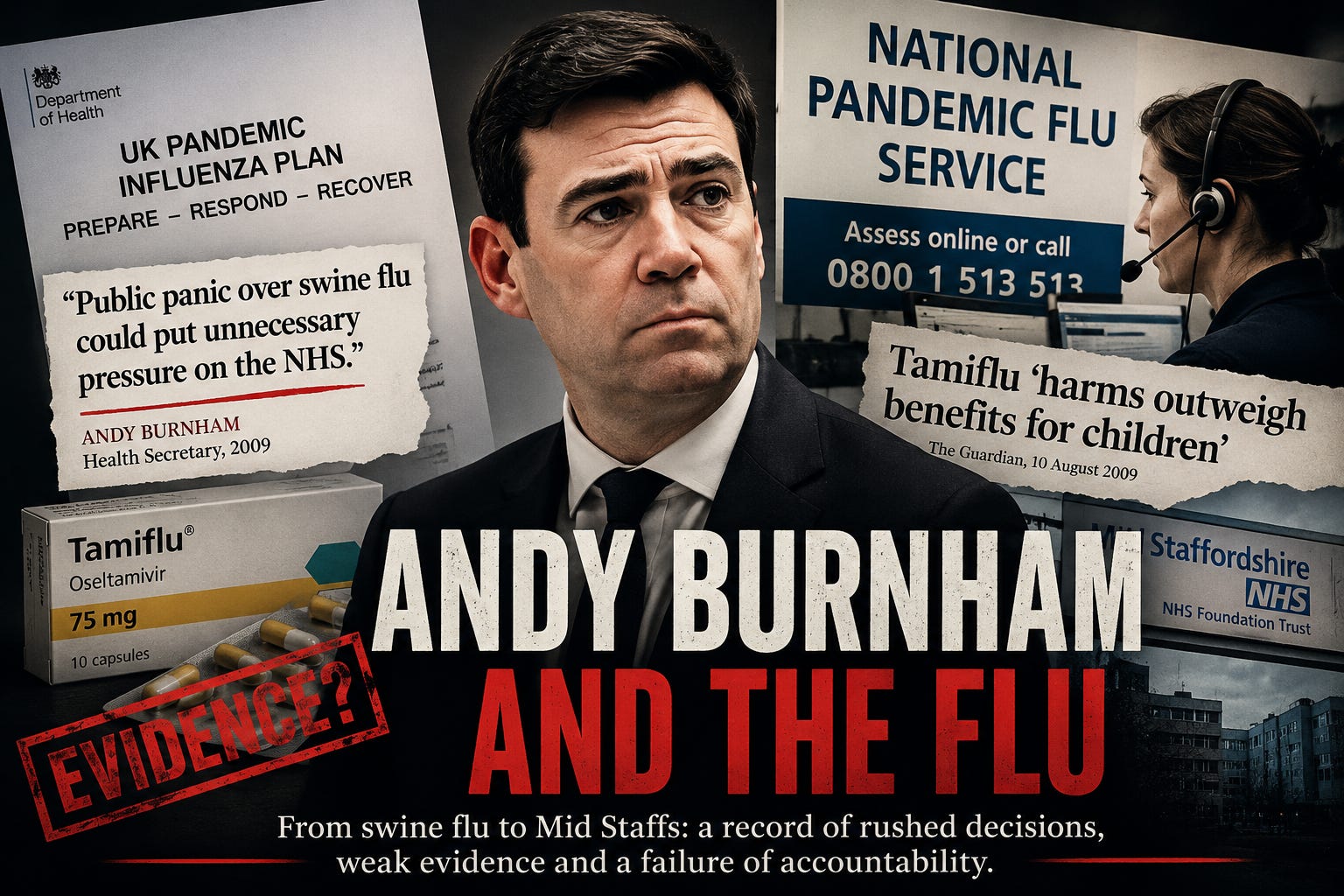
An election is underway in Blighty that may well determine who occupies Number 10 in the years ahead.
Among those seeking a route back to Westminster is Andy Burnham, the long-serving Mayor of Greater Manchester, who is standing in Makerfield and has made little secret of his ambition for higher office. If Labour eventually goes looking for its next leader, Burnham’s name will feature prominently.
Yet many have forgotten that Burnham has already had a close encounter with a pandemic. In 2009, as Health Secretary in Gordon Brown’s government, he found himself at the centre of the “Swine Flu” crisis.
In April 2009, the government announced it would increase its stockpile of antivirals from 33.5 million courses to 50 million. Within the first two weeks of the pandemic, half a million courses had reportedly been prescribed nationwide. Ministers warned of the risks ahead; the media amplified projections, and experts appeared daily on television screens. Sound familiar?
By July, however, Burnham was telling the House of Commons something rather different. For the vast majority of people, he said, swine flu remained “a mild and self-limiting illness”, and public advice had not changed. At the same time, he warned that public panic could place unnecessary pressure on the NHS.
Then came one of the more extraordinary innovations of the pandemic.
On 23 July 2009, when Britain had recorded a grand total of ten deaths, the government launched the “National Pandemic Flu Service”. Patients were told they no longer needed to contact their GP. Instead, they could complete an online assessment or speak to a call centre operative. If “swine flu” were deemed likely, an authorisation number would be issued and a designated “flu friend” could collect antiviral drugs from a local distribution centre.
The machinery of mass pharmaceutical intervention was assembled at remarkable speed. However, there was just one problem: The evidence underpinning these antivirals was already under serious challenge.

Around the same time, the two old geezers raised concerns about Tamiflu and Relenza. Questions were emerging about both effectiveness and safety, particularly in children. We warned that the harms of Tamiflu could outweigh any benefits in under-12s. Yet the policy rolled relentlessly forward.
We repeatedly argued that the Department of Health should reassess its pandemic flu strategy. The evidence base was incomplete, key trial data remained inaccessible, and the claims being made for the drugs often exceeded what the published evidence could support.
What followed was a four-year struggle to obtain the underlying clinical study reports from manufacturers and regulators. It became one of the most important transparency battles in modern medicine.

Working with the BMJ and the Cochrane Collaboration, we eventually secured access to thousands of pages of previously unseen data. The findings challenged many assumptions that had justified vast public expenditure on antiviral stockpiles.
Governments around the world had spent billions preparing for a pandemic based on claims that were, at best, uncertain. Policy had raced ahead of evidence. The parallels with later events are striking.
Burnham’s supporters may argue that he was merely implementing the advice available at the time. There is some truth in that. Ministers do not personally conduct systematic reviews or analyse clinical trial data. But leadership is about more than accepting prevailing wisdom: It is about asking difficult questions when billions of pounds and public trust are at stake.
The same issue arises elsewhere in Burnham’s ministerial record. He was Health Secretary during the Mid Staffordshire scandal, in which a toxic combination of target-chasing, managerialism and institutional defensiveness contributed to appalling failures of care. The Francis Inquiry later exposed a culture in which warning signs were missed, concerns were dismissed, and accountability was elusive. Burnham has long rejected suggestions that he bears responsibility for what occurred.
Perhaps. But political leadership inevitably entails responsibility for the systems one presides over. Ministers cannot claim credit when things go well and retreat into helplessness when they do not.
As Burnham seeks a return to national politics, voters might reasonably ask what lessons he learned from 2009.
The “swine flu” pandemic ultimately proved far less severe than many feared. The antiviral stockpiles did not deliver the transformative benefits that had been promised. The evidence base turned out to be far shakier than policymakers assumed. And years later, independent reviews concluded that future pandemics would require better clinical trials, improved evidence generation, and greater transparency.
The question for Burnham is simple. Looking back now, does he believe the government got it right?
Because for those of us who spent years fighting to uncover the evidence behind pandemic policy, one lesson stands above all others: when politicians insist they are “following the science”, the first task is to make sure the science is actually there.

The two old geezers who wrote this post have been working on the f-word for a while.
Are there any senior politicians who are likely to be in the running who've not committed similar errors? That is the question. I've no confidence in any of these people to provide the leadership that Britain needs desperately but that goes across all parties. Essentially there was an all-party consensus. Any debate about the Swine Flu or Covid-19 was completely disallowed. The system seems to drive any form of real debate underground. Something rotten with the state of Westminster, me thinks.
There were many things we could have learned from the UK Swine flu panicdemic response. From my perspective it seemed we either learned the wrong lessons or drew the wrong conclusions about what to do better next time.
The first lesson from Swine Flu was that having a hotline for diagnosis and prescribing of antivirals staffed by lay people is a bad idea and leads to predictable harms https://www.mirror.co.uk/news/uk-news/fears-over-swine-flu-bad-410845. Personally I think that could have been anticipated and avoided the first time.
In round 2 (Covid) we no longer had lay people staffing the hotlines, but we still had remote triage and hotlines for diagnosis. When a nation has been encouraged to panic, services inevitably can't cope with the predictable rise in demand, so some form of remote triage is necessary. However I think too many barriers were put up preventing face to face clinical assessment of people who needed to be seen, and it was a mistake to exclude GPs from this process. Serious diagnoses were still missed and misdiagnosed as Covid and later as Long Covid, due to the bias to diagnosis and the emphasis on avoiding face to face contact. Resources in the community were diverted towards single diagnosis Covid assessment centres. In areas like ours these services were not needed, and it was hugely wasteful, with teams of highly trained emergency care practitioners not doing their usual job for far longer than initially envisaged.
The second lesson from Swine Flu was that though GPs may be better than lay people at distinguishing what is clearly not 'swine flu', it isn't really possible to make a firm diagnosis of 'swine flu' clinically, as it doesn't have any distinct characteristics compared with a myriad of other viruses and non virus causes of flu like illness: https://www.theguardian.com/world/2009/jun/17/swine-flu-misdiagnosis-tests. I think this probably spawned the mass testing and moonshot approach of Covid, but then there was also a blatant disregard for the accuracy of testing and testing ironically became disconnected from clinical symptoms.
I'm not optimistic that we have learned from the covid testing fiasco and that it won't just happen again in the same way next time, unless we are completely bankrupt by round 3, which we might be. But somehow we always seem to find money for wars and pandemics.
The third lesson should have been when considering committing huge sums of public money to antiviral stockpiles, those in charge of decisions need to dig a bit deeper and not just take the word of industry or of those with conflicts of interest who are set to profit enormously regardless of whether said intervention has a net overall benefit or harm.
Some people did very well indeed from the pandemic response, and the Covid inquiry was a whitewash, so I am noy optimistic about any lessons being learned there either..
I also suspect that some things will never make sense because we are dealing with decisions made by the military pharmaceutical industrial complex and it is entirely possible that some of what we experienced was testing systems. So it doesn’t really matter who is in govt the next time, if they are not and never were the ones calling the shots.